
RAGE Is How You LOSE In Music! – How To Respond To Bad Reviews
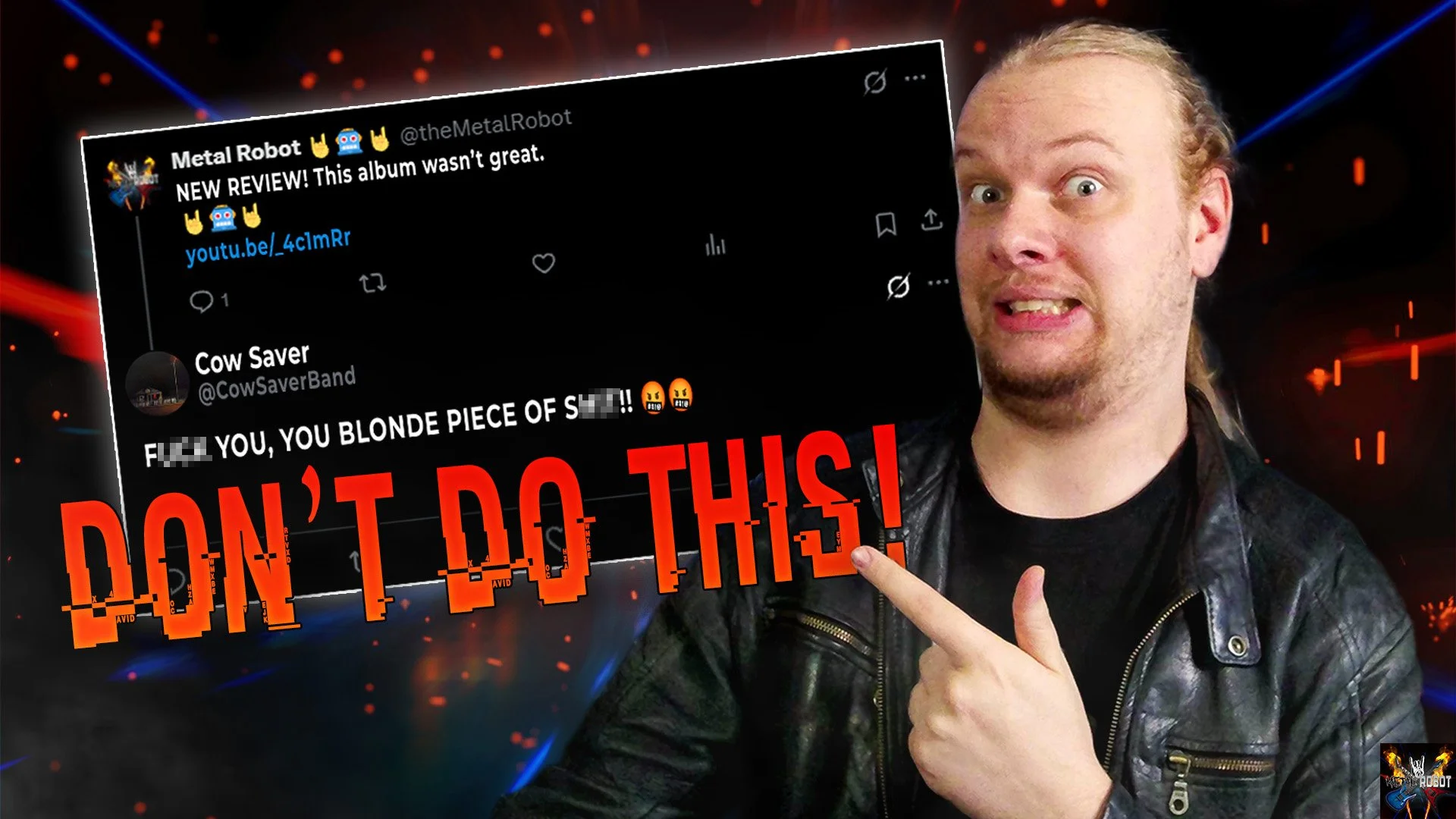
How you respond to getting panned by critics and fans matters more than you realize. Because it shows your overall character, and that could determine your future as a band.
Look, you probably don’t like being told that something you poured your heart, soul, blood, sweat and tears into sucks donkey balls. Whether you've spent years writing your magnum opus or just a few months putting together your debut album, having some random jackass with long blonde hair and a leather jacket on the internet tearing it apart isn't something you want to see or hear about. Rejection like that on a public scale is infuriating to hear, and can make you feel really bad about something you loved.
But here's the thing: getting a bad review isn't going to hurt your music career…
How you respond to that review will!
As a music critic, and also a musician with music available for review, there are better ways to handle all three situations. Over time, I’ve seen some bands who have demonstrated exactly how to respond amazingly!
Others? Well, they've provided some excellent examples of what NOT to do.
Getting Angry Is Normal. Getting Angry ONLINE Is Where You Screw Up.
Here's the truth: getting angry or upset because somebody took a dookie on something you created is completely normal.
Afterall, you put time, money, and all your creative energy into making something you're proud of! And now, somebody (whom, let’s be honest here, you’ve probably never met) is telling the world that it hurts so much to listen to, they threw their headphones at the cat. Of course that's going to sting!
But there's a massive difference between getting angry about a review, and publicly attacking the person who wrote it. And that difference could have some pretty serious consequences for your music career.
Sure, your fans might rally behind you. They might agree that the critic is an idiot, doesn’t know what they’re talking about, and flood your comments with messages of support. And that’s great!
… But what about everybody else?
Think about the publicists who might want to work with you, or already do work with you. If they see you publicly having a meltdown every time somebody gives your music a 2 outta 10 on Reddit, they're probably going to have some concerns about how difficult you might be to work with going forward.
They’re the ones who work with you to help get your music out there, so burning random bridges is a huge red flag.
And if you're the person responsible for managing your band's social media accounts, your bandmates might not be particularly thrilled with you either.
Because when you respond to criticism online, you're not just representing yourself. You're representing everybody involved with the band.
A great example of this (outside of literally all of Trapt’s twitter beef):
BackWordz vocalist Eric July, the first vocalist for Fire From The Gods, wasn't particularly happy when one of my music reviewer idols Crash Thompson, formerly known as The Rock Critic on YouTube, reviewed the band's only album to date, Veracity.
In the original review, Crash tore the album apart. It was glorious to watch, because he tore apart Eric’s terrible rapping, questionable composition choices, and ham-fisted approach to political lyric writing (somehow done while also giving off “I’m cool shit, daddy! Why won’t you love me” energy, seriously this thing sucked), while also praising Fire From The Gods as a point of comparison for everything that sucked with Veracity.
Eric apparently didn't appreciate that. He responded on Twitter with:
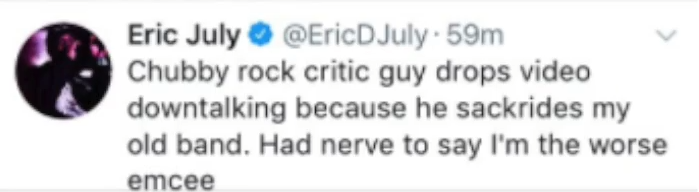
Screenshot of Eric July’s tweet, taken from Crash Thompson’s Top 10 WORST of 2017 video.
… Yeah, no. If that doesn’t scream “wah, someone was mean to me, please shower me with compliments”, then I don’t know what does.
Seriously though, it comes off as Eric being more butt hurt than a 43-year-old basement dweller shouting at kids in an old Modern Warfare 2 lobby.
It’s showing a personality, but not a good one.
Now I couldn’t find the original tweet (the dude loves Twitter way too much, this was years ago), but I know about this because of how Crash responded. And how he responded shows what can happen when you behave poorly on the internet.
Crash saw the tweet, and proceeded to take a screenshot of Eric’s classy response, and sent it to Eric's former band, Fire From The MF Gods, with the caption:
"He sounds like he was a fun guy to work with. 🙃"
And months later, Crash showed the exchange to his audience on his video “The Top 10 WORST Albums of 2017”, calling Eric a little bitch.
Now, regardless of whether you agree with Crash's original review, or even his response, you need to ask yourself:
What exactly did Eric accomplish here?
Did he convince Crash that the album was better than he thought? Did he win over anybody who wasn't already a fan? Did he make himself look like somebody who handles professional criticism particularly well?
The exact opposite.
I guess it did get Crash to talk about him again, but despite what you might’ve heard, bad press is not good press.
And here's something bands should remember: music critics are often journalists, too.
While Crash might not do interviews, plenty of others, such as myself, do! We also write features, promote new releases, and introduce our audiences to bands they might not have heard of otherwise.
That’s something to keep in mind, because burning that bridge because you threw a tantrum on Twitter is a bad way to get your music to more people.
I’ve not run into this specific situation myself, but I know that I wouldn’t want that person on my show anytime soon, even if they came back with a new album that’s a potential Album of the Year banger.
That's potentially one less platform willing to give your music exposure. At my level, that’s not a problem, but imagine if you piss of Metalsucks? Metal Injection? Rocked? Anthony Fantano? What are you gonna do then?
I'm not saying you should be nice to critics because they deserve some special treatment. I'm saying you should think about this from a promotional standpoint. Why burn a bridge when you don't have to?
And it's not just journalists you need to think about, sometimes your own fans might hate what you made. Maybe they liked your old stuff, or just don’t like the direction you’re taking this new album in. Are you gonna shit on someone who’s a fan just because they had the audacity of having their own music taste?
That’s actually happened (Trapt comes back into mind, god help me), and it makes people not want to support you in your dream job.
So, what's a better response?
Honestly, something as simple as being polite, thanking the person for checking out your music, and moving on.
I recently reviewed Beyond Eternity, the new album from After Infinity. I compared the experience to ordering fast food where the picture on the menu looks significantly better than what you actually receive.
Essentially, I thought the album was all flash and no substance. Not exactly a glowing endorsement.
But instead of getting upset and telling me where I could shove my opinion, After Infinity responded to my review on Instagram with this:
"Thanks for the brutal honesty man 😂❤️ hope we nail it with the next one! And who knows, maybe this album will grow on you too with a few more listens 😉"
And you know what? Mad respect.
They took the criticism on the chin, thanked me for checking out their music and being honest about my thoughts, and even threw in a little humour.
They didn't have to agree with anything I said. They didn't have to promise to change their sound or make guarantees to write their next album specifically to satisfy me. They simply acknowledged the review, responded like decent human beings, and moved on.
That's how you do it.
But What If the Critic Is Being a Complete Dick?
Okay, but what happens when your anger actually feels justified?
Not because somebody disliked your album, but because they were genuinely being an asshole about it.
Maybe they made unnecessarily personal comments, went out of their way to mock you, or maybe they seemed more interested in making you look stupid than actually reviewing your music.
Surely THAT deserves some kind of angry response, right?
NOPE.
Because every single problem I mentioned earlier still applies. And in some cases, responding angrily can make things even worse.
Nobody Wins a Twitter War
There's a reason people love watching celebrities and public figures fight with each other online. Drama is entertaining to watch!
But it also means that, when you publicly start fighting with a critic, there's a good chance other people are going to get involved.
Your fans might start attacking the reviewer. Their audience might start attacking you. Suddenly, what should've been a simple disagreement over an album has turned into an online shitshow.
And once that happens, you have no control over where things go. That’s another way to get blacklisted in the music industry overall. Especially when it turns out the bully is actually a sweetheart…
You Don’t Know What’s REALLY Going On
A guy I knew a while back told me a story about a bad review he wrote. To say this review was really harsh is about the same as saying Dave Mustaine was a little salty about getting fired from Metallica.
I can’t remember exactly what he said, or what album it was about, but he was on a fucking war path with this album. He treated it like it had kicked his dog (I’m exaggerating, but he really didn’t like that album)
The band didn’t get mad about it, but they did respond to him. And they found out why his review read like a political hit.
It turns out, this person was having a helluva shit kind of day. I remember him saying there was a lot of personal stuff going on behind the scenes, and that anger and frustration fueled into his thoughts on an album he didn’t like.
His opinion on the album didn’t change, but he definitely owed that band an apology (which he did).
We critics are human afterall. Sure, it sucks to be torn apart for your creative works, but don’t immediately assume they are out to get you.
So, what should you do when a reviewer is genuinely being a bully?
Well, remember how you were taught how to respond to bullies in school? Sadly there’s no teacher you can tell. But, you can make their insults meaningless, or turn their jokes into your own…
I was a bit of a dick back then
Story time: Back in 2021, I reviewed an album from Siren's Rain, called Rise Forth. You can still find the video online, I’ll even embed it below. It’s a video I still think about and point to when considering how I write reviews going forward. Both the good… but also the bad.
In that video, I made lots of jokes, including one where I decided to train a herd of alpacas to spit on my taint (comedy, ladies and djentlemen, give this man an emmy).
This is because I was pissed about the poor production choices, was confused by some of the composition choices, and felt bored overall.
Anyway, I later heard from their PR representative that the band thought I was a dick in that video. Which, frankly, is understandable, I had a hard time distinguishing “funny” and “dickhead”.
But publicly, Siren's Rain responded with:
And that was it. No angry rant. No personal attacks. No lengthy Twitter thread about how some stupid Canadian metalhead doesn't understand their artistic vision. They took it on the chin, and moved on.
That response made me really think about how I did reviews from then on. While I wouldn't change any of the legitimate criticisms I made about that album, or change the video itself, I would go back to 2021, kick my younger self in the nuts, and leave without offering any explanation, because that dickhead deserved it.
There's nothing wrong with being harsh in a review. There's nothing wrong with making jokes, either. But there's a difference between criticizing somebody's creative work with a bit of humour and simply being unnecessarily cruel because you think it'll get a laugh.
And Siren's Rain handled that situation significantly better than I deserved.
… but what if you decide to be a comedian about it?
Turning an Insult Into a Punchline
When TDW (really awesome prog metal musician, you should totally check out every time he’s been on my podcasts) released The Days The Clock Stood Still, which got as high as Number 4 on my BEST of 2020 list.
It did, however, receive a pretty negative review from Angry Metal Guy.
Among the criticisms, the reviewer referred to TDW's music as "manbun metal." Which was certainly a description, I don’t know if I’d even go that far.
Now, TDW could've responded by attacking the reviewer, complaining about how unfair the criticism was, or writing a lengthy statement defending the artistic merits of manbuns. Manbuns are truly the metalcore of mens hairdos. People hate it, but they just don’t understand it yet.
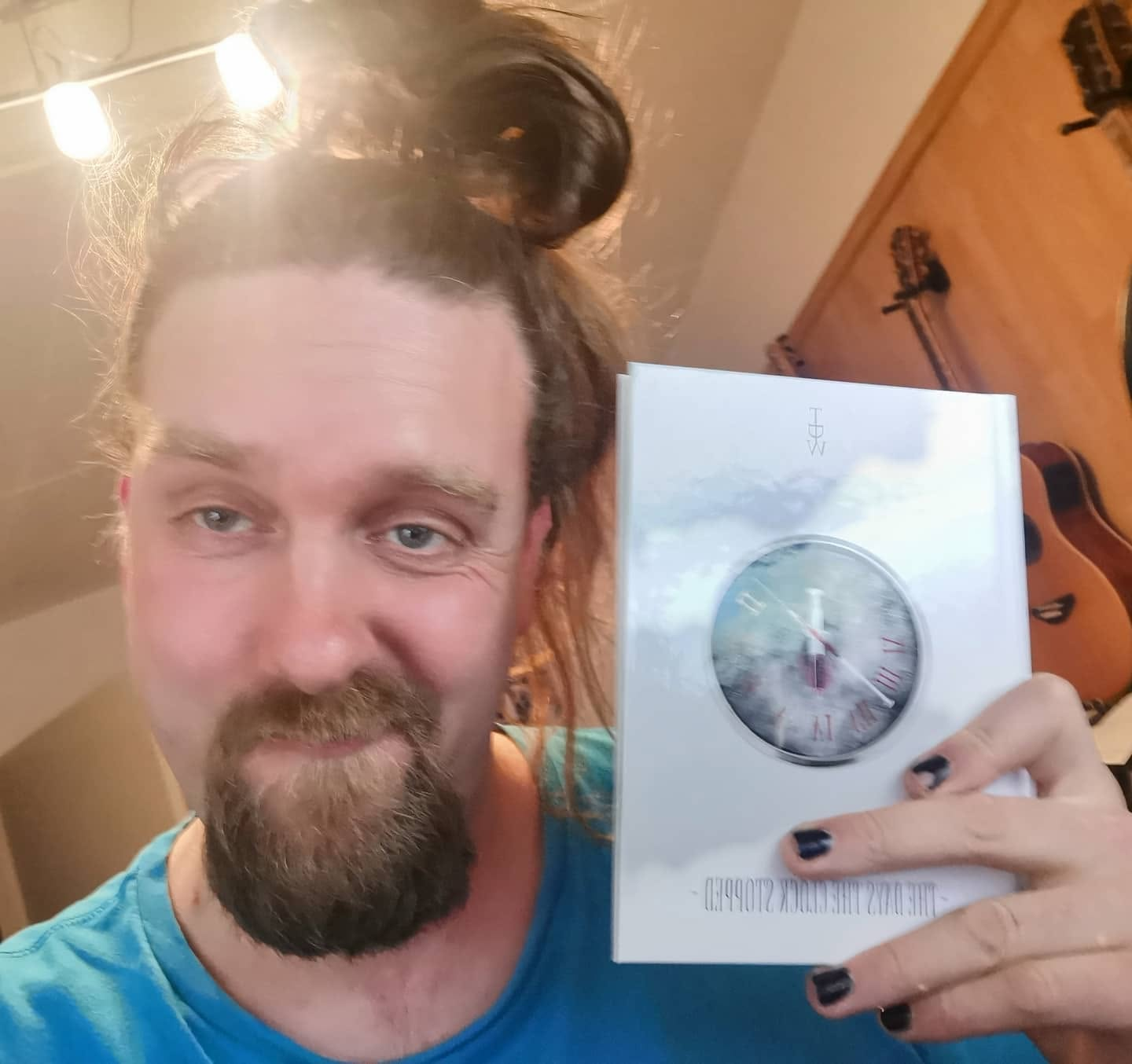
Anyways, TDW commented on the article itself with:
"Thanks for the review guys. ;) Made this to thank you:"
And attached a link to a Twitter post (he’s no longer on Twitter) with a picture of himself with the most gloriously ridiculously sized manbun, with the caption:
“Just want to thank Angry Metal Guy for their 'incredibly constructive' review of "The Days The Clock Stopped".
Hope that I now apply to their manbun prog-album criteria.
https://www.angrymetalguy.com/tdw-the-day-the-clocks-stopped-review/
Also love to everyone in the comment section who apparently have a hard time getting that manbun style working. Keep trying mah dudes and dudettes, one day the manbun will come to ya.”
Beautiful, hilarious response I still talk with him about to this day.
Rather than treating the insult as some devastating attack on his musical integrity, he embraced the joke and made it his own.
And Angry Metal Guy loved it! In fact, the response earned TDW even more respect from the reviewer. That's the beauty of handling criticism with humour.
You can completely disarm somebody's insult without ever needing to insult them back.
And when you can laugh at yourself, it shows people that you're comfortable enough with your own work that a bad review isn't going to send you into a complete meltdown.
But all of this begs the question:
Should You Even Listen to the Hate?
If you've been paying attention to the Call of Duty franchise over the last few years (stay with me, I do have a point), you'll know that the recent Modern Warfare games haven't exactly been knocking it out of the park when it comes to their campaigns.
Modern Warfare II (2022) and Modern Warfare III (2023) received plenty of criticism over their story modes, whether it was poor storytelling, questionable pacing, or the increasingly obnoxious push toward Warzone-related shenanigans.
Modern Warfare III in particular was considered by many to have the worst campaigns in Call of Duty history (Needless to say, that game was very happy when Black Ops 7 came out, we don't talk about that nonsense, fuck you Microsoft.)
Anyway, people talked a LOT of shit about these games. Sometimes arguably more than they deserved.
But the developers saw those responses, recognized where things weren't working, and actually addressed many of those complaints with the newest title, Modern Warfare 4, pushing to deliver a better campaign overall.
What’s my point? It’s simple: Sometimes, the people criticizing your work actually have some valid points.
I know. Shocking. A music critic saying he’s got some good points. What a concept.
But for real, as uncomfortable as it might be to read an article or watch a video of somebody taking a steaming hot mountain of dino shit on your creative vision, it’s not like they’re doing so without giving a reason as to why. If you pay attention, there's a possibility they're identifying genuine problems with your music that you never thought of.
Maybe the songwriting wasn't particularly strong. Maybe the production sounded like it was recorded through a potato. Maybe the album was unnecessarily long, or maybe the songs just didn't have enough variety to justify their runtime.
I made my EP Call To The Daemon Sultan by getting feedback from people who knew what they were talking about, and were able to point me in a better direction. I like many of the changes I made in that EP, because they sound better than how it started.
Now, does that mean you have to listen to EVERY SINGLE criticism somebody throws your way? Of course not! Does that mean every piece of criticism is valid? Not at all!
Music is subjective. You're not obligated to agree with every review, and sometimes the person reviewing your album might have completely missed what you were trying to accomplish.
Hell, I remember criticizing Lindsay Schoolcraft’s Martyr for having heavily programmed drums. I love that album, but at the time I felt the super robotic drums didn’t give the album a hard enough impact. But Lindsay pointed out to me that she intentionally went that route. She liked how they sounded, it reminded her of her influences, it was part of her vision. She’s not dismissing my points, but she knew what she was doing.
But flat out dismissing criticism simply because you don't like the opinion in the headline is a fantastic way to ensure you never learn anything from it.
Read the reviews. Consider what's being said. Take whatever constructive feedback you find useful, and leave the rest behind. Just don't let your emotions do the talking when you decide to respond.
But honestly, this next one is by far the easiest response that the big bands do all the time…
Silence; The Strongest Response.
Here's something that might sound painfully obvious. You don't actually HAVE to respond to a negative review.
Seriously. I know, after all of this, that’s the easiest one (thank you for reading this far anyways, luv u <3)
You can read the review, disagree with every single word, close the tab, and continue living your life. The review can’t hurt you when it’s not even opened.
And sometimes, ignoring a review is the smartest decision you can make.
Look at bands like Metallica and Megadeth. These are some of the biggest names in metal history, with decades of successful releases and enormous fanbases. They (what a shock) still get bad reviews.
Dave Mustaine in particular has a reputation for holding grudges, but even he understands that there are times when responding to criticism is a good idea and times when it's better to leave things alone.
You don't have to defend every single creative decision you've ever made. And you certainly don't have to convince every critic that they're wrong.
Take Avenged Sevenfold, for example.
They've been getting a LOT of shit recently because of their more recent... well, I hesitate to call them "music" releases (sorry, but as a super fan, STATICA can fuck off back to the acid induced A.I. void).
But despite the amount of criticism they've received, they generally don't seem particularly interested in directly responding to every negative opinion. Occasionally, they'll address things when an interviewer brings them up, or make a vague statement onstage about how people hated City of Evil back in the day. Otherwise, they largely just get on with doing whatever it is they're doing.
And honestly, that's probably the right approach. Because, again, what exactly would they gain by responding to every single person who doesn't like their new material?
Would they suddenly convince everybody that their latest creative direction is brilliant? Hell no. Would they potentially make things worse by drawing even more attention to the criticism? Possibly.
And that's something worth remembering regardless of how big your band is.
Not every opinion deserves a response, and not every argument is worth having.
Sometimes, the best thing you can do is say absolutely nothing. Take that energy you would put into your response, and put it towards making your next album a raging banger.
It might be difficult, especially when somebody is tearing apart something you're genuinely proud of. But ignoring the criticism publicly means you don't have to deal with the consequences of responding poorly.
No unnecessary arguments. No angry social media posts. No public relations nightmare.
Just you, your music, and whatever you decide to create next.
At the end of the day, getting a bad review isn't the end of the world.
It might hurt. It might piss you off. And sometimes, you might even have a legitimate reason to think the person reviewing your music is a complete asshole.
But none of that means you have to respond in anger.
You can acknowledge the criticism and thank the reviewer for their honesty, like After Infinity. You can take a nasty joke and turn it into something genuinely funny, like TDW. Or you can simply ignore the review and move on with your life.
And while you're at it, don't be afraid to actually consider some of the criticism you're receiving. You might discover something that helps make your next album even better.
Whatever approach you choose, don't make rash judgements or responses based purely on how angry you feel in the moment. Because ultimately, a bad review says something about your music from their perspective. But how you respond to that opinion tells everybody something about YOU from YOUR actions.
And unlike a bad album review, a bad reputation can be significantly harder to recover from.
WANT YOUR MUSIC REVIEWED ON THE SHOW!?
Send your albums, EP’s, singles, EPK’s, etc. to my email:
tmckay@themetalrobot.com
-or-
tommckay.themetalrobot@gmail.com


Lindsay Schoolcraft returns to the Metal Robot Podcast to talk about her new album Harrowing. Plus, we review new releases from Shadowborne, Conflux Collective, and Drakkar before spinning the Metal Archives Roulette wheel into Moldova to discover Neuromist.